


Part 1 – The New Urban Reality
- Dec 1, 2025
- 6 min read
THE NEW URBAN REALITY: WHY PREPAREDNESS MATTERS MORE THAN EVER

Introduction: A World Growing More Unpredictable
Walk through any major city today—New York, Los Angeles, London, Chicago, Dallas—and you’ll notice the same thing: modern life feels fast, crowded, and interconnected. We depend on systems we cannot see and often don’t understand—electricity, water treatment, transportation, food distribution, communication networks, digital finance, and emergency services. For decades, these systems felt solid and unshakable.
But today, that confidence is fading.
Extreme weather events are breaking historical records. Infrastructure failures happen more frequently. Social tensions rise and fall in waves. Cyberattacks target essential services. Supply chains that once felt invincible are now fragile. Cities—our hubs of innovation—have also become environments where a single disruption can ripple outward into chaos.
Urban survival and preparedness are no longer fringe concepts or topics reserved for doomsday thinkers. They are practical, rational approaches to living in a world where uncertainty is part of daily life. Whether you’re a parent in an apartment building, a commuter in a crowded metro system, or a professional working downtown, understanding how to navigate urban vulnerabilities gives you an advantage and peace of mind.
This installment kicks off the Urban Survival and Preparedness Series by grounding you in the truth about modern cities—what makes them strong, what makes them vulnerable, and why preparedness is now essential for everyone.
Why Cities Are More Fragile Than They Appear
1. High Population Density
Urban environments pack millions of people into dense areas. This creates a cascade effect when things go wrong:
Resources deplete quickly
Grocery stores carry only 2–3 days of food.
Evacuation becomes difficult
Only a few roads; millions of cars.
Services strain under pressure
Hospitals, fire departments, and police can be overwhelmed in minutes.
Density amplifies every threat, from disease spread to panic buying.
Population Density is a measure of how many people live in a specific area, usually calculated as the number of people per square mile. A higher population density means more people live close together, while a lower density means people are more spread out.

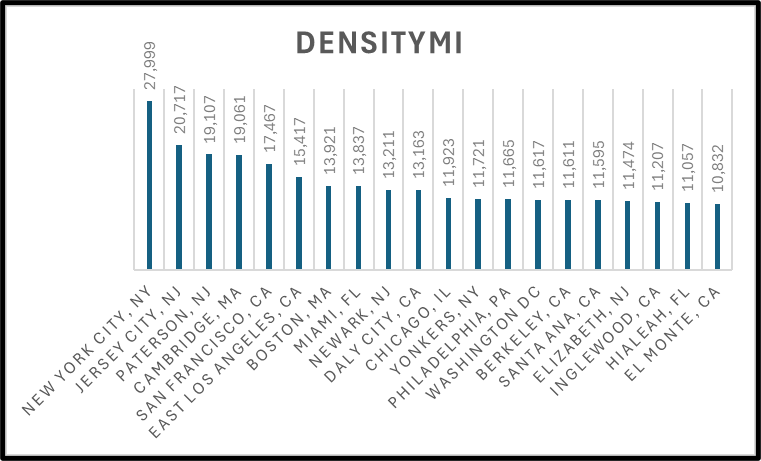
Looking at the Top 20 most populated cities out of 359 cities in the United States, you see Texas has 5 cities that are amongst them. Houston – 3.8 million, San Antonio – 1.5 million, Dallas – 1.3 million, Fort Worth – 1 million (Combined DFW – 2.3 million), and Austin – 1 million.
But when you look at the density per square mile, Texas does not come close to the top 20, except for the combined DFW area. Houston (#155) – 3, 767 / mi, San Antonio (#191) – 3, 104 / mi, Dallas (#144) – 3, 921 / mi, Fort Worth (#211) – 2,938 / mi, (Combined DFW (#44) – 6, 859 / mi) and Austin (#197) – 3,066 / mi.
One thing to keep in mind is how cities grow and swallow up or combine with other smaller “cities/towns” to where you can’t really tell where one ends and another starts. Look at the DFW area; Arlington, Irving, Plano, Grapevine, Mesquite to name a few that blend into the greater DFW area. You can also see this with Albuquerque, San Antonio, Austin, Pheonix, etc.
2. Supply Lines Are Long and Complex
Most cities produce almost none of their own food. A single trucker strike, port shutdown, or fuel shortage can cause empty shelves within days. During the COVID-era disruptions, cities like New York and San Francisco saw just how quickly supply chains can fail under stress.
The average urban resident is only three missed meals away from crisis instinct.
3. Infrastructure Is Aging and Overloaded
Water mains burst. Electrical transformers fail. Bridges crack. Power grids strain. Transit systems falter.
Many infrastructure systems were built 50–100 years ago and are pushed far beyond their intended capacity.
This creates a dangerous reality:
Modern cities are built on outdated foundations.
4. Dependence on Technology Has Outpaced Resilience
We rely on digital systems for:
Payments
Navigation
Communication
Identification
Security
Transportation scheduling
If these fail—due to cyberattack, EMP, software bugs, or grid failure—most people have no fallback method.
Ask yourself:
How much of your daily life stops if your phone dies?
5. Increased Weather Extremes
Climate volatility is now normal. Cities have experienced:
Floods in subway systems
Wildfires reaching urban edges
Polar vortex freezing power grids
Heat domes stressing electrical systems
Category storms hitting regions previously deemed “safe”
Urban environments magnify weather damage due to heat islands, drainage limitations, and outdated building standards.
6. Social Tensions and Civil Unrest
Urban centers are uniquely vulnerable to:
Protests
Riots
Looting
Police shortages
Crowd-control failures
Political demonstrations
Flash mobs and mass panic events
Large populations + high stress = rapid destabilization.
Preparedness is not about fearing others; it’s about understanding human behavior under stress.
Why Urban Survival is Different from Wilderness Survival
Many people associate survival skills with the wilderness: shelters, fire-making, hunting, water sourcing.
Urban survival is fundamentally different.
Urban Survival Prioritizes:
Situational awareness
Movement and navigation
Blending in / “grey man” strategies
Avoiding bottlenecks
Understanding choke points
First aid
Evading crowds
Communication
Evaluating human behavior
Accessing safe structures
Resource mapping
Initially, it’s less about starting a fire with sticks and more about:
Getting home safely, avoiding danger, keeping your family safe, and maintaining stability.
Note: If the situation keeps getting worse, you might eventually need to find water and cook over a fire.
Urban survival is practical, modern, and directly applicable to everyday life.
Case Study: How Quickly an Urban Crisis Escalates
Let’s walk through a realistic scenario:
DAY 1 — POWER GRID FAILURE
Power goes out across the city.
Cell networks go down (most towers depend on grid power).
Traffic lights shut off.
Subways stop.
People assume it’s temporary.
DAY 2 — WATER ISSUES BEGIN
Water pressure drops.
ATMs stop working.
Credit card networks fail.
Stores go cash-only.
DAY 3 — FOOD AND SUPPLY SHORTAGES
Shelves empty.
Police resources stretch thin.
Small-scale theft begins.
DAY 4–7 — STRESS AND UNREST
Fuel runs scarce.
Temperature control (AC/heat) fails.
Crime spikes.
First responders triage only the most critical cases.
People realize help may not be coming.
WEEK 2–4 — MIGRATION AND CHAOS
Mass attempts to flee the city.
Highways logjammed or blocked.
Conflicts over resources rise.
Vulnerable populations suffer most.
This pattern has played out in real cities before:
New Orleans (Katrina), New York (Sandy), Venezuela’s blackout, Texas 2021 freeze, Puerto Rico’s power collapse.
Urban crises cascade quickly.
Preparedness isn’t extreme—it’s statistical realism.
Preparedness Isn’t Fear—It’s Responsibility
Preparedness isn’t about bunkers or paranoia. It’s about:
Reducing stress in an emergency
Keeping your family safe
Remaining calm when others panic
Having options when infrastructure fails
Avoiding desperation
Becoming an asset instead of a liability
Prepared people help their communities, not drain them.
Preparedness = empowerment.
The Four Pillars of Urban Preparedness
This blog series is built around four essential pillars:
(Link to my Preparedness Pyramid Blog):
1. Mindset
The foundation of all survival.
You will learn how to:
Stay calm
Assess situations quickly
Avoid dangerous zones
Manage stress
Think clearly under pressure
Mindset determines survival more than gear ever will.
(Link to my Mindset Blog):
2. Skillset
Skills replace panic and improvisation.
You’ll learn:
Urban medical skills
Communication techniques
Navigation without electronics
Fire safety and building hazards
Knowledge weighs nothing and goes everywhere with you.
(Link to my Skillsets Blog):
3. Tactics
Tactics bring together your skillsets into realistic TTPs that enhance your survivability.
You’ll learn:
Situational awareness
Evasion and movement
Blend in (Gray Man)
Understanding your own ability and applying it to each scenario is critical to you getting home.
(Link to my Tactics Blog):
4. Toolset (Kit)
You will build practical, realistic gear setups:
EDC (Everyday Carry)
GHB (Get-Home Bag)
Vehicle kit
Emergency home supplies
Tools support your skills and mindset—not the other way around.
(Link to my Kit Level Blog):
The Growing Importance of Community
Urban survival is not solo survival.
Cities thrive on interconnectedness.
Likewise, urban survival and preparedness thrives on Mutual Assistance Groups (MAGs).
Shared skills
Shared resources
Shared knowledge
Shared security
Shared problem-solving
No one thrives alone in a long-term urban crisis.
Community is a survival multiplier.
Conclusion: The Future Demands Preparedness
Urban vulnerabilities are not speculative—they are measurable, observable, and increasing.
Preparedness is the modern expression of responsibility, awareness, and self-reliance.
By investing in your mindset, skills, tactics, tools, and community, you’re not preparing for the end of the world.
You’re preparing for the real world


Comments